I am conducting consulting work in Hawaii and always looking for interesting projects here, or elsewhere. Please contact me to discuss possible projects.
My expertise is multidisciplinary but mainly falls into the fields of marine ecology and conservation, invasion biology, oceanography, community ecology, evolutionary biology, and limnology. Research questions of interest are both applied and theoretical. I have conducted research in Africa, Australia, Canada, U.S., and the Galapagos including manipulative field experiments complimented with broad-scale surveys to test theory and better understand drivers of large-scale patterns in nature. I endeavor to identify important biotic and abiotic factors controlling the diversity of an ecosystem in order to better inform managers and policy-makers. My research to date has focused on monitoring, managing and modeling the spread of invasive species. Invasive species are a global, daunting problem causing over $120 billion dollars of damage, each year, in the US alone. They are one of the leading causes for biodiversity loss and the number of invaders exponentially increases each year. I focus on marine invasive species, as marine invasion biology lags behind its counterparts in terrestrial and aquatic systems. I have used the Asian shore crab (Hemigrapsus sanguineus) and European green crab (Carcinus maenas) as model organisms. This research was mainly conducted from New Jersey to Maine, USA. More recently, I expanded my research to tunicates by studying the invasion of the vase tunicate (Ciona intestinalis), which threatens the multimillion dollar mussel industry of Prince Edward Island, Canada. I also studied the biology, ecology, and conservation of sharks, rays, and skates in South Africa and manta rays, nudibranchs, and ecotourism in Mozambique.
EDUCATION
2016-2017: Post-doctoral Researcher, Biology,
University of Hawaii - Manoa, Department of Biology, Honolulu, Hawaii, U.S.A.
Funding from N.O.A.A. and conducted in collaboration with Conservation International
2005-2009: Doctor of Philosophy in Marine Biology and Conservation, McGill University, Department of Biology, Montreal, Quebec, Canada
2000-2004: Bachelor of Science, Water Environments and Ecosystems – Biological Focus, McGill University, Faculty of Agricultural and Environmental Sciences, Montreal, Quebec, Canada
Conducted data analysis on multiple projects involving fish biology, conservation, genetics, and resource management, including analysis for a $2,000,000 study
Developed an equation-based multistate model to estimate the survival, movement, and detection probabilities of fish in the Sacramento-San Joaquin Delta
Project lead on a study conducted by consultants and governmental agencies
Generated over $200,000 in profit for the company
Research Fellow: Oceans Research, Mossel Bay, Western Cape, South Africa May 2012-Jun. 2013
Principal investigator on a multifaceted, multimillion dollar project
Supervised multiple honors students
Wrote papers based on the datasets produced by the laboratory personnel
Director of Research: Oceans Research, Mossel Bay, Western Cape, South Africa Nov. 2011-May 2012
Simultaneously managed 16 research projects focusing on sharks and marine mammals
Supervised the research organization during its most productive publishing year
More than tripled the number of scientific permits the organization received
Published papers in peer-reviewed scientific journals (e.g. Marine Biology, PLOS One)
Principal investigator on multiple research projects and supervised the budgets of all research projects
Principal Investigator: Oceans Research, Mossel Bay, Western Cape, South Africa Apr.-Nov. 2011
Conceived, designed, implemented, sustained, and analyzed the data for a mark-recapture study
Conducted original research on various marine species with a focus on sharks and marine mammals
Created and presented a 4-hour seminar and hands-on workshop on statistics and designing experiments. This seminar was given every month
After three months, I was promoted to the Scientist in Residence position
Wrote grants and obtained research funds from various funding bodies
Taught four honors-level courses on general biology and ecology
Taught senior-level course on human anatomy and physiology
Taught previously designed lesson plans and ones that I created
Created a productive and positive classroom environment for learning
Won the Hingham High School Teacher of the Week Award
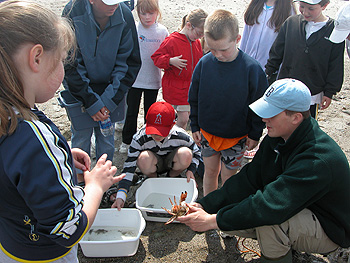
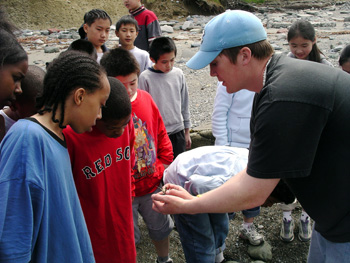
Harbor Discoveries Instructor: New England Aquarium, Boston, Massachusetts, U.S.A. Jun.-Oct. 2010
Trained students to collect accurate data on the abundance of intertidal species for the New England Aquarium, Na.G.I.S.A., and Census of Marine Life databases
Supervised data collection to ensure the protocol was executed properly
Coordinated and organized a conference for researchers, volunteers, and the public
Planned, designed, and implemented a complete curriculum for four different themes of an environmental and marine-based education program
Taught on a variety of topics in biology, ecology, and marine sciences
Supervised and maintained group dynamics to optimize work success, safety, and enjoyment of the students, parents, and staff
Research Assistant: Zavora Marine Laboratory, Zavora, Mozambique Mar. 2010
Conducted visual surveys of recreational scuba divers activities to establish their impact on the health of coral reefs, benthic communities, and manta rays
Executed standardized coral reef monitoring protocols (e.g. Reef Check) to monitor long-term impacts on reef structure and diversity
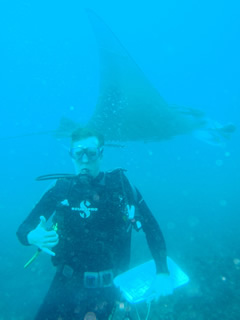
Conducted underwater photo-identification of manta rays and whale sharks
Field Assistant: Oceans Research, Mossel Bay, Western Cape, South Africa Feb. 2010
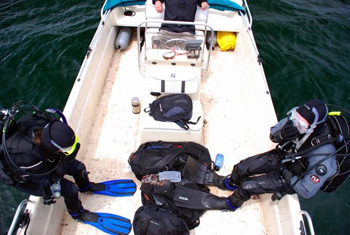
Conducted photo identification and mark-recapture methods to establish and monitor the population status and abundance of sharks and marine mammals
Executed genetic and stable isotope sampling of sharks
Used acoustic telemetry equipment to track the movement of white sharks
Research Assistant: McGill University, Montreal, Quebec, Canada Sep. 2008-Jun. 2009
Conducted a study on the sustainability of student response systems (i.e. clickers) in undergraduate science classes to determine if it is worth investing up to $500,000
Created paper-based questionnaires to assess the students’ satisfaction with clickers
Conducted clicker-based surveys of students’ perception and satisfaction of clickers by conducting in-class surveys in courses taught at McGill University
Co-authored a peer-reviewed publication based on this study
Published papers in peer-reviewed scientific journals (e.g.Biological Invasions, Ecology, Ecological Applications) and presented the results at scientific conferences (e.g. E.S.A)
Co-principal investigator on a N.O.A.A. funded grant (~$200,000)
Took courses on biometry, geographical information systems, and statistics
Created and validated a large-scale citizen science monitoring network involved 1,000 volunteers that more than 50 sites along seven states (New Jersey to Maine)
Conducted field experiments, surveys, recruitment studies and computer modeling
Created, trained, and sustained a 1,000 person volunteer-based monitoring network that documented the distribution of native and invasive species by in person training, creating training manuals, field guide, and on-line learning tools
Each year, gave dozens of lectures and hands-on workshops to the scientific community, teachers, students, and the general public
Each semester I was a teaching assistant for one or two university-level courses
Research Assistant: McGill University, Montreal, Quebec, Canada Sept.-Dec. 2004
Coded a model that optimally used sparse data to forecast the spread of species
Prepared a successful grant proposal for funding from N.O.A.A.
Co-authored a peer-reviewed publication in Ecological Modelling
Executive Director: Invasive Tracers, Montreal, Quebec, Canada Mar. 2004-Apr. 2011
Recruited, trained, and supervised 7,000 volunteer “citizen scientists” to monitor over 60 sites from New Jersey, U.S.A. to Prince Edward Island, Canada to participate in my research
Gave 500 presentations to diverse audiences for training and fund raising, including the key note address for the New England Aquarium’s Conservation Fundraising Night
Co-produced an educational video featuring an interview with Dr. J. T. Carlton
Conducted data analysis and wrote peer and non-peer reviewed publications
Obtained and renewed collection and scientific research permits from 7 state-level governmental conservation agencies and federal parks
Visiting Scientist: Charles Darwin Research Institute, Galapagos, Ecuador Feb.-Mar. 2004
Collected Darwin’s finches by mist net then took beak measurements, bite force data, blood samples, banded, and released the individuals
Conducted ethological studies on the feeding habits of Darwin’s finches
Banded, took blood samples, weights and beak measures of various species of birds including Darwin’s finches
The data was published in Proceedings of Royal Society of London Series B. Biological Sciences
Harbor Discoveries Instructor: New England Aquarium, Boston, Massachusetts, U.S.A. Jun. 2002-Aug. 2004
Conducted formal and informal education in the classroom, field sites, and at sea
Taught curriculum on various topics of environmental and marine sciences
Paid Intern: Massachusetts Department of Environmental Boston, Massachusetts, U.S.A. Jun.-Aug. 2001
Helped implement and expand a state regulation and the Rideshare Program
Maintained a Microsoft Access database of all businesses in Massachusetts
Publications:
PEER-REVIEWED PUBLICATIONS Delaney, D.G., Teneva, L.T., Stamoulis, K.A., Giddens, J.L., Koike, H., Ogawa, T., Friedlander, A.M., and Kittinger, J.N.. Patterns in artisanal coral reef fisheries revealed through local monitoring efforts. PeerJ. Available at: https://peerj.com/articles/4089.
Merz, J.M., Delaney, D.G., Setka, J.D., and Workman, M.L. 2016. Seasonal rearing habitat in a large Mediterranean-climate river: management implications at the southern extent of Pacific salmon (Oncorhynchus spp.). River Research and Applications. 32(6): pp 1220–1231. DOI: 10.1002/rra.2969. PDF.
Joseph E. Merz, Paul S. Bergman, Joseph L. Simonis, David Delaney, James Pierson, Paul Anders. 2016. Long-Term Seasonal Trends in the Prey Community of Delta Smelt (Hypomesus transpacificus) Within the Sacramento-San Joaquin Delta, California, Estuaries and Coasts pp 1-11. DOI: 10.1007/s12237-016-0097-x PDF.
Delaney, D.G., Bergman, P., Cavallo, B.J., and J. Melgo. 2014. Stipulation Study: Steelhead Movement and Survival in the South Delta with Adaptive Management of Old and Middle River Flows. The document was reviewed by representatives from the California Department of Water Resources, National Oceanic and Atmospheric Administration (N.O.A.A.) National Marine Fisheries Service, University of Washington, and United States (U.S.) Fish and Wildlife Service, and Bureau of Reclamation. http://baydeltaoffice.water.ca.gov/announcement/Final_Stipulation_Study_Report_7Feb2014.pdf
Delaney, D.G., Cavallo, B., Bergman, P.S., Hinkelman, T., and Courter, I. 2015. A life-cycle model for partially anadromous rainbow trout in Battle Creek, California: Model documentation.
Delaney, D.G., Bergman, P., Cavallo, B.J., and Melgo, J. 2014. Stipulation Study: Steelhead Movement and Survival in the South Delta with Adaptive Management of Old and Middle River Flows.
Delaney, D.G., Bergman, P., Cavallo, B.J., and J. Melgo. 2013. Phase II Data Analysis Plan for the Acoustic Telemetry Stipulation Study (for the Salmonid Mark-Recapture Study). The document was reviewed by representatives from the California Department of Water Resources, N.O.A.A. National Marine Fisheries Service, Bureau of Reclamation, U.S. Fish and Wildlife Services, and the Westlands Water District.
Delaney, D.G., Johnson R.J., Bester M.N., and Gennari E. 2012. Accuracy of using acoustic telemetry data and visual identification of white sharks (Carcharodon carcharias) to estimate residency patterns. PLoS ONE. 7(4): e34753. doi:10.1371/journal.pone.0034753 http://dx.plos.org/10.1371/journal.pone.0034753
Delaney, D.G., Edwards, P.K., Leung, B. 2012. Predicting regional spread of invasive species using oceanographic models - validation and identification of gaps. Marine Biology 159: 269-282.PDF
Delaney, D.G., Griffen, B.D., Leung, B. 2011. Does consumer modify invasion impact? Biological Invasions. 12: 2935-2945. PDF
Delaney, D.G. and Leung, B. 2010. An empirical probability model of detecting species at low densities. Ecological Applications 20: 1162-1172. PDF
Delaney, D.G. 2009. Monitoring and managing the spread of marine introduced species: development of approaches and application to the European green crab (Carcinus maenas) and the Asian shore crab (Hemigrapsus sanguineus). Ph.D. dissertation, McGill University, Montreal, Quebec, Canada.
Delaney, D.G., Sperling, C.D., Adams, C.S. and Leung, B. 2008. Marine invasive species: validation of citizen science and implications for national monitoring networks. Biological Invasions 10: 117-128. PDF
Griffen, B.D. and Delaney, D.G. 2007. Species invasion shifts the importance of predator dependence. Ecology 88: 3012-3021. PDF
Leung, B. and Delaney, D.G. 2006. Managing sparse data in biological invasions: a simulation study. Ecological Modelling198: 229-239.PDF
NON-PEER-REVIEWED PUBLICATIONS Delaney, D.G., Teneva, L.T., Stamoulis, K.A., Giddens, J.L., Koike, H., Ogawa, T., Friedlander, A.M., and Kittinger, J.N. Patterns in artisanal coral reef fisheries reveal best practices for monitoring and management. Available at: https://peerj.com/preprints/3076v1/.
De Carlo, E.H., and Delaney, D.G. Resource management, water quality, and biological monitoring plan for Maunalua Bay, O'ahu, Hawai'i Artificial Reef Project.
Delaney, D.G., Cunningham, D., and De Carlo, E.H. 2016. Benthic study report. Prepared for Hawai'i Memorial Reefs and permitting agencies (e.g. Hawai'i Department of Land and Natural Resources [D.L.N.R.], U.S. Environmental Protection Agency [U.S.E.P.A.], N.O.A.A., U.S. Army Corps of Engineers [U.S.A.C.E.], and U.S.F.W.S.).
Delaney, D.G., and Cunningham, D. 2015. Benthic study report for a proposed artificial reef permit area in Maunalua Bay, Oahu. Prepared for Hawai'i Memorial Reefs.
Bergman, P., Delaney, D.G., Merz, J.E., and Watry, C. 2014. A Pilot Mark-Recapture Study using Spot Patterns of Oncorhynchus mykiss in the Stanislaus River, California. Technical report for Bureau of Reclamation.
Delaney, D.G., Bergman, P., Cavallo, B.J., and Melgo, J. 2014. Review of comments and author responses on the November 2013 Draft of the stipulation study. 125 pages.
Delaney, D.G. 2012. Shark feeding dives - A shark expert's opinion on a controversial practice. About.com: the reference website for the New York Times Company.
Delaney, D.G. 2011. Is Scuba Diving With Sharks Dangerous? About.com: the reference website for the New York Times company.
Delaney, D.G. 2011. Striving to save sharks in South Africa. Dedham Country Day Bulletin.
Delaney, D.G. 2010. The global threat of invasive species. Beyond Blue. PDF
Delaney, D.G. 2009. Report on the European green crab, Carcinus maenas. Center for Agricultural Bioscience International Invasive Species Compendium.
Delaney, D.G. 2008. Verifying the validity of volunteer monitoring to increase its utility: An academic perspective. U.S. Environmental Protection Agency’s The Volunteer Monitor. PDF
Delaney, D.G. 2007. In the Spotlight: The Marine Invasive Species Monitoring Organization. The National Institute of Invasive Species Science Citizen Science Newsletter.
Delaney, D.G. 2006. Meet the scientists. National Sea Grant’s Nab the Aquatic Invader Website.
Delaney, D.G. 2005. Asian shore crab spreads north. The Massachusetts Office of Coastal Zone Management Newsletter (C.Z. Mail).
Delaney, D.G. and Solecki, A. 2005. Citizen science as a solution to invasive species. Gulf Stream Newsletter: A publication of the Gulf of Maine Marine Educators’ Association.
PEER-REVIEWER OR EXPERT OPINION FOR GOVERNMENTAL DOCMENTS
Asian Carp in the Great Lakes Region. A summary report for Members of the U.S. Congress. Buck, E.H., Upton, H.F. and Stern, C.V. In Press. Congressional Research Service.
Risk assessment for the Chinese mitten crab (Eriocheir sinensis) and the European green crab (Carcinus maenas) in Canadian waters. 2010. Therriault, T.W., Herborg, L.M., Locke, A. and McKindsey, C.W. Fisheries and Oceans Canada.
Identifying significant range extensions of invasive marine pests – C.C.I.M.P.E. Range Decision Guidelines Project. Darbyshire, R. and Caley, P. 2009. Australian Government’s Bureau of Rural Sciences.
Marine Pest Incursions – A tool to predict the cost of eradication based on expert assessments by Crombie, J., Knight, E. and Barry, S. 2007. Australian Government’s Bureau of Rural Sciences.
AWARDS
2012 Principal Investigator on a multimillion dollar project - South African Collaborative Shark Study
2011 Hingham High School Teacher of the Week Award
2009 G.R.E.A.T. / G.T.C. Travel Award ($500)
2009 Alma Mater Student Travel Grant Award ($750)
2008 Gulf of Maine Visionary Award
2007 University of Maine’s Addison E. Verrill Award for Marine Biology ($2,000)
2006 McGill Graduate Studies Fellowship Award ($5,000)
2005 Co-P.I. on a grant from N.O.A.A.’s National Sea Grant ($205,755)
2005 Ecological Society of America’s E.C. Pielou Award ($200)
2005 McGill Graduate Studies Fellowship Award ($5,000)
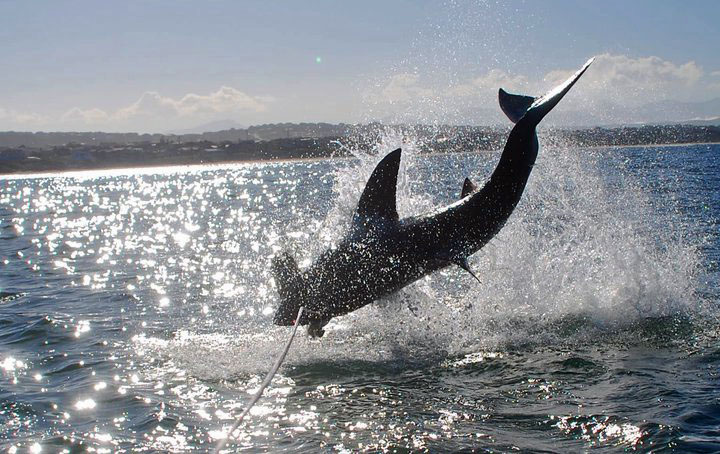
SHARKS: My current research interests are topics in the field of marine biology and conservation. I am currently focusing on the biology, ecology, and conservation of elasmobranch fishes (sharks, rays and skates), applied fisheries biology, and physiological ecology of fishes. More specifically: 1) tracking the abundance and residency of white sharks (Carcharodon carcharias) and bull sharks (Carcharinus leucas) using acoustic telemetry and photo identification; 2) devising strategies to reduce the mortality of released elasmobranch fishes by recreational fishermen and discarded bycatch in commercial fishing operations; 3) documenting diurnal and weekly movement patterns of C. carcharias; and 4) identifying ways to minimize human-shark interactions by understanding the patterns of daily activities for both groups. This information will further research on the species and guide management of elasmobranch fishes, which is critically important since tens of millions are killed every year for consumptive (e.g., meat, shark fin cartilage) and non-consumptive reasons (e.g., their jaws, teeth, or simply a picture of them). Therefore my research answers both pure and applied research question and directly relates to a current global environmental problem.
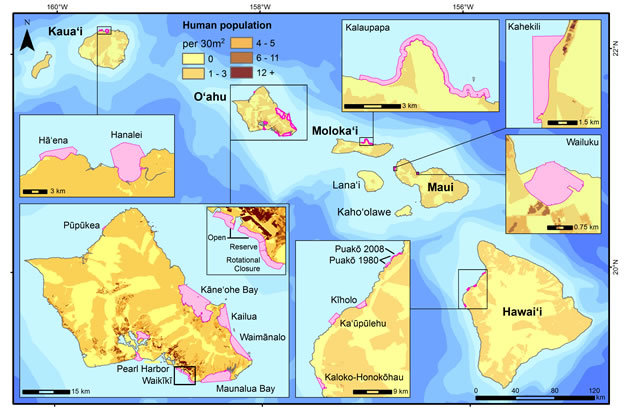
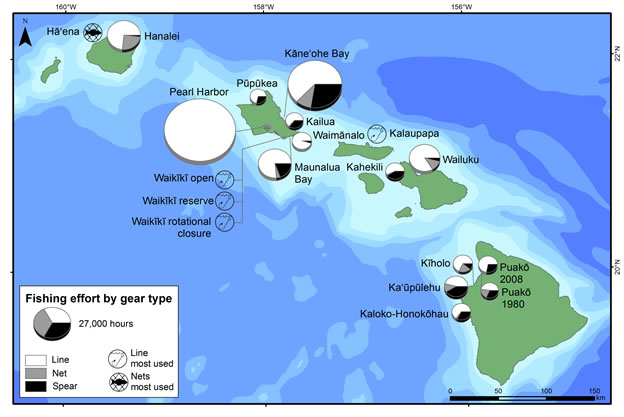
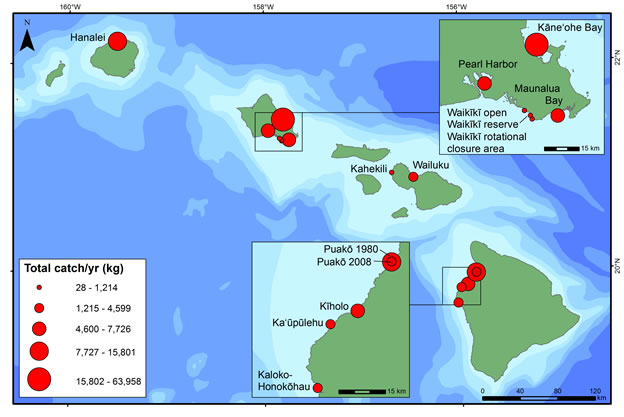
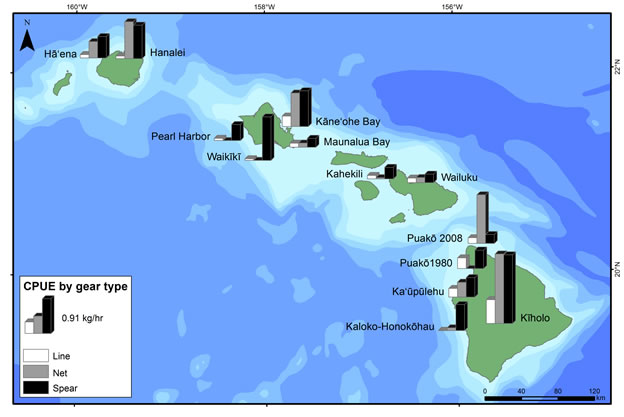
CORAL REEF FISH: Sustainable fisheries management is key to restoring and maintaining ecological function and benefits to people, but it requires accurate information about patterns in resource use, particularly fishing pressure. In most coral reef fisheries and other data-poor contexts, obtaining such information is challenging and remains an impediment to effective management. We developed the most comprehensive regional view of shore-based fishing effort and catch for the Hawaiian Islands to show detailed fishing patterns from across the main Hawaiian Islands (MHI). We reveal these regional patterns through fisher “creel” surveys conducted through collaborative efforts by local communities, state agencies, academics, and environmental organizations, at 18 sites and comprising >10,000 hr of monitoring across a range of habitats and human influences throughout the MHI. Here, we document spatial patterns in nearshore fisheries catch, effort, catch rates (i.e., catch-per-unit-effort [CPUE]), and catch disposition (i.e.,use of fish after catch is landed). Line fishing was consistently the most commonly employed gear type (94%), followed by net fishing. The most efficient gear types (i.e., higher CPUE) were spear (0.64 kg hr-1), followed closely by net (0.61 kg hr-1), with CPUE for line (0.16 kg hr-1) 3.9 times lower than spear and 3.7 times lower than net. Creel surveys also reveal rampant illegal fishing activity across the studied locations. Surprisingly, overall, most of the catch was not sold, but rather retained for home consumption or given away to extended family, which indicates that cultural and food security may be stronger drivers of fishing effort than commercial exploitation for nearshore coral reef fisheries in Hawai‘i. Increased monitoring of spatial patterns in nearshore fisheries can inform targeted management, in order to maintain these fisheries for local communities’ food security, cultural, and ecological value.
Figure 1. Survey sites where creel and/or fish flow surveys were conducted and included in this study are shown in pink.
Figure 2. Shore-based fishing effort by gear type.
Figure 3. Total catch per year (kg) at each site.
Figure 4. Catch-per-unit-effort (CPUE - kg hr-1) for the three dominant shore-based fishing gears (line, net, and spear) by survey location.
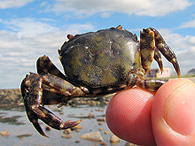
CRABS: As widely
distributed organisms, Carcinus maenas
and Hemigrapsus sanguineus were
logical choices for this new type of study and
validation towards yielding the data needed for
the progress of marine invasion ecology.
Carcinus maenas has invaded the coasts of
North America, South Africa, Australia, South
America and other places outside of its native
range of the Atlantic coast of Europe and possibly
northwest Africa. Carcinus maenas was
presumably brought to the Atlantic coast of North
America, in 1817, with solid ballast. By 1989, it
started colonizing the Pacific coast of North
America starting in San Francisco Bay. It was
transported accidentally from the east coast by
activities associated with the live food and bait
trade. Establishment and persistence in these
various environments is likely facilitated by its
omnivorous feeding strategy and its ability
to tolerate a wide range of temperatures and
salinities. A single brood of C. maenas
can contain 185,000 - 250,000 eggs. High
fecundity and the characteristics of a generalist
allow C. maenas to inhabit a diverse
range of marine ecosystems and therefore, reduce
beta-diversity.
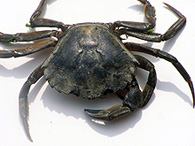
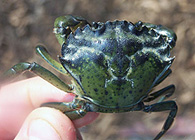
Carcinusmaenas European Green
Crab
Carcinus
maenas 5 teethed green
crab
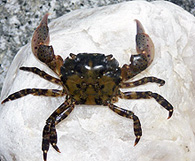
Hemigrapsussanguineus Asian Shore
Crab
Hemigrapsussanguineus Photo credit: Flickr Dr.
Jennifer Forman Orth
Similarly,
H. sanguineus is a generalist, an
omnivore, and a highly invasive brachyuran crab.
Hemigrapsus sanguineus is native to the
western Pacific but has colonized multiple
locations in Europe and during 1988 it was first
detected on the eastern coast of North America, in
New Jersey. Traffic of foreign cargo vessels was
presumably the vector that brought the Asian shore
crab to North America. In its native range, H.
sanguineus inhabits waters that range from
above 30 to below 5 oC. With a high fecundity in
the form of multiple broods of up to 60,000 eggs
each breeding season, H. sanguineus has
expanded its invasive range along the eastern
coast of the United States, and has colonized from
Oregon Inlet, North Carolina to Schoodic
Peninsula, Maine.
SELECTED LIST OF ORAL PRESENTATIONS
Association for the Sciences of Limnology and Oceanography's Aquatic Sciences Meeting. February, 2017. Creel surveys as tools for more effective monitoring and management of coastal fisheries and seafood security in Hawai'i. Also, I organized and chaired the contributed oral session on fish.
Hawai'i Memorial Reefs. 2016. The potential for artificial reefs in Bermuda.
China's Institute of Hydrobiology and Academy of Sciences. 2015. Monitoring, managing, and modeling the spread of marine invasive species.
California‐Nevada Chapter of the American Fisheries Society 48th annual conference. 2014. Challenges of predicting the movement of juvenile steelhead in the Sacramento‐San Joaquin Delta.
8th Biennial Bay-Delta Science Conference. 2014. The importance of identifying and quantifying fish behaviors to predict the migration rate of juvenile salmonids.
Mossel Bay Marine Laboratory Presentation Series. 2012. Global ocean conservation.
Mossel Bay Marine Laboratory Presentation Series. 2011. Marine issues facing South Africa.
United States Fish and Wildlife Service's National Chinese Mitten Crab Workshop. 2010. Lessons from research on the European green crab and Asian shore crab for national monitoring.
16th International Conference on Aquatic Invasive Species. 2009. Application of citizen science and search theory to optimally detect a species at low density.
Canadian Society for Ecology and Evolution Annual Meeting. 2008. False negatives: Exactly how reliable is presence-absence data? Also I chaired a session of oral presentations on the topics of theoretical ecology.
Fifth International Conference on Marine Bioinvasions. 2007. Are citizen scientists the solution to early detection?
Canadian Conference for Fisheries Research and Society of Canadian Limnologists. 2007. To detect or not to detect: Do ecologists properly interpret survey data?
90th Ecological Society of America annual meeting. 2005. Predicting discrete secondary spread of aquatic invasive species, which won the E.C. Pielou Award for the best oral presentation on statistical ecology. Also, I chaired the contributed oral session on invasive species of the Great of Lakes of North America.
Shark Wranglers. 2012. “Shark Wranglers” is a television series that will be broadcast on the History Channel and documents the expedition and disseminates the information of the South African Collaborative Shark Study for which I was a project leader
ResearchSA. 2012. Ocearch - Sharkmen permits reissued after no link found between research and fatal shark attack.
Mail and Guardian. 2012. Team defends shark research by Fiona MacLeod
Cape Times. 2012. It wasn't our fault, say shark scientists
Moneyweb Daily News. 2012. Department of Environmental Affairs suspends the Ocearch / Sharkmen research permit - Following the fatal attack of a body-boarder at Kogel Bay
The Scenic South. 2012. Great White Sharks in False Bay Tagged for Research
Shark Year magazine. 2012. DEA Press Release: New permit for Shark Research Project Issued
St. Francis Chronicle. 2012. R15 Million Shark Research Project and Film in False Bay
Newsletter of Massachusetts Association of Science Teachers. 2011. Monitoring Invasive Crab Species in Boston Harbor: Boston Public School Students and Citizen Science by Tom Hocker
The Guardian. 2011. Great white shark jumps from sea into research boat by Xan Rice
The Atlantic. 2011. What to Do When a Great White Shark Jumps in Your Boatby Alexis Madrigal
Fox News. 2011. Great White Shark Jumps Into Research Boat in South Africa CNN. 2011. Great White Jumps on to Research Boat
South Coast Today. 2006. Highlighting volunteer monitoring network by Brian Fraga
Patriot Ledger. 2005. David Delaney is the pied piper of science by P. Amy MacKinnon
BBC News. 2004. Galapagos tortoises held hostage - More than 30 scientists and several giant tortoises are being held hostage by striking fishermen in the Galapagos Islands.





 - for web.jpg)